|
|
|
|
|
|
|
|
|
|
|
|
|
|
|
|
|
|
||||||||||||||
|
|
|
|
||||||||||||
|
|
|
|||||||||||||
|
|
|
|||||||||||||
|
|
||||||||||||||
|
|
|
|
||||||||||||
|
|
|
|
|
|
|
|
|
|
|
|||||
|
|
||||||||||||||
Designing Desires Workshop
"Doors of Perception 3," Amsterdam, November 1995
Group Led by A T Mann
The Doors of Perception 3 Conference in Amsterdam, The Netherlands, was held in November 1995 and was co-sponsored by The Netherlands Design Institute, Domus Academy of Milan, the Royal College of Art, London and the Royal Melbourne Institute of Technology. The twelve workshop groups and the conference itself explored ways in which information technology and design can contribute to sustainability, specifically the mental and material changes that must be made in order to achieve a sustainable future. The purpose of the workshops was to create various info-eco scenarios that could be used by design schools and designers in the future. I was invited to run one of the twelve Professional Design Workshops.
The Challenge
What new ideals could direct the way we cultivate desires with our product design and guide us to more sustainable patterns of consumption?
It is not difficult to distinguish hundreds of desires that are driving forces in our lives. When we try to determine which of these desires are the most important to us, we discover that we have an enormous list of WANTS, but minimal actual NEEDS. In fact, we spend most of our lives trying to get or own a great range of wants which do not correspond at all to our real needs. Ultimately, life is not about needs, not even about desires: life is about meaning.
The Participants
- A T Mann – Group Leader, Architect, Author & Astrologer, Denmark
- Tulga Beyerle – Teaching Assistant, Hochschule fur Angewandte Kunst, Vienna, Austria
- Niels Peter Flint – o2 International, Denmark
- Juoni Linkola – New Media Studies, University of Art and Design Helsinki, UIAH, Finland
- Sytze Kalisvaart – o2 Global Network, The Netherlands
- Bob Adams – Interval Research Corporation, Stanford University, USA
- Bianca Maasdamme – Ministry of Spatial Planning and the Environment, Directorate-General for Environmental Management, The Netherlands
- Egidio Reale – PhD Anthropology, Columbia University, USA
- Tim Parsey – Design Manager, Industrial Design Group, Apple Computer Inc., USA
- Nancy Spanbrook – Lecturer, Curtin University, Australia
- Stefan Tax – Social Scientist Researcher, KPN Research, The Netherlands
- Agnes Willenborg – Interaction Designer, Lijn Vier Multimedia Design, The Netherlands
- Ronan Hallowel – Student of Philosophy and Religion and DJ, USA
- Fred Manskow Nymoen – Designer, Art Center College of Design, USA
- Jan -Christoph Zoels – Industrial Designer, Jan van Eyck Academy, The Netherlands
Our workshop was called "Designing Desires: Fluid Functionality and Less as More." The commissioning experts – Danish architect and designer Niels Peter Flint, Dutch industrial designer Sytze Kalisvaart and I – chose the subject matter. The brief we created stated that: "We blame consumerism for its wastefulness, but what can we learn from the numerous and subtle ways in which it stimulates our desires? What new ideals can inform the way we cultivate desire with our product design and guide us to a more sustainable future? How can we do more than just marvel at the psychological power of status symbols, fashion and fetishism to generate demand?"
The experts and I created and developed the initial proposal. We represented three diverse points of view that we felt could and should be integrated. Niels Peter’s background is the theatre, both acting and designing sets, and he is as well eco-conscious designer, architect and retailer of recycled and ecological products. Sytze is an industrial designer working with the Dutch government and an independent consultant in Holland. Both are founder members of o2 International designers’ organization devoted to furthering eco-design awareness. Their original "outer" intention of the week was to create the first o2 collection of virtual objects reflecting eco-product development philosophies joining the two poles. I am an architect and author, and have taught and used the principles of symbolism, guided imagery, esoteric principles and psychosynthesis and other therapeutic models with students and in my consultation work for more than 25 years. Therefore I modified our statement of purpose to ask:
How can we use internet-upgraded product functionality, life-style affirmation exercises, eco-impact visualizations and new product/desire combinations to realize our new ideals?
My feeling is that designing virtual objects is unlikely to supply the meaning that is missing from our lives and designs. We blame consumerism for its wastefulness, but refuse to look at how and why we desire products, people, love and money, etc. Desire itself becomes a life goal only in societies (and for individuals) where spirit and meaning has been lost. The paradox is that the more we acquire those objects that should satisfy our desires, the less we are satisfied, the more we want and ultimately the more impossible any kind of satisfaction becomes. I feel that the only transformations that can lessen, refocus, sublimate, eliminate or transcend desires lie in the domain of "the sacred." This represents a higher and more humane value towards which to direct the group.
I quickly reframed the above proposition as: The only transformations that can lessen or eliminate desires lie in how we create meaning. Ancient sacred traditions were based upon a spirituality that came from the integration of heaven and earth, symbolically applied over the millennia to alphabets, calligraphy, languages, visual symbols and fetishes, architecture, sexuality, music, clothing, jewelry, weapons, tools and other meaningful mechanisms. These rich traditions have been disappearing (or are disappearing day by day) from our world, yet they remain within us all, available to the dream state, to meditative awareness, creative visualization and other techniques of ecstasy, awaiting reactivation. Formerly living symbols have been lost or replaced by dead (de)signs. Rediscovering or recreating sacred symbols in the world or evoking them within the psyche means creating a human ecology, a consciousness of and then a balance between above and below, male and female, consciousness and nature, light and dark, outer and inner, physical and metaphysical.
Webster's Dictionary defines the word "design" as "an underlying scheme that governs functioning, developing or unfolding." But design is also a "decorative pattern." It is essential that we know which type of design we practice. Most contemporary design education encourages objectivity, detachment, and fosters an awareness of prevailing styles or mechanistic expressions, which leads inexorably to the sterility of much of modern design. At the higher level I believe that we can "de-sign," turn away from conventional meaning towards more complex and holistic inner concepts. Specific creative challenges, guided imagery visualization exercises, identification with the designed object, symbol-nurturing inner journeys and explorative drawing exercises can bring designers into touch with the ultimate source of inspiration within and away from the stagnation of materialist and mechanist agendas which tempt them from without. I would ask. Dare we express the sacred in the mundane?
The Workshop
The twenty participants in our workshop were prominent designers, educators, musicians, journalists, philosophers and students. Our group members were from twelve countries and spoke eight different languages. The expectation was that they would learn to experience new ways of working together which would lead them to create new processes and systems for their design work in the future.
My co-leaders had suggested to me that our point of departure should be to design a laptop for the year 2050, which reflected our group’s concerns about future ecology and information technologies. The experts imagined that the group would create a gallery of virtual objects that would replace the need for physical consumption. Given my psychological perspective and experience working with the inner nature of people, I believed that the search for meaning in the future would be a powerful component of any approach to the problem of Factor Twenty. (A reference to the fact that in the future we will be required to live on one-twentieth of the resources we use today). As Moderator of the group, it was my responsibility to determine the structure of the five days. I decided to create the workshop as an experiential path with much less emphasis on actual design and more on attaining sustainable quality life in the future.
Left Brain – Right Brain
It is axiomatic in modern psychology and brain research that the left hemisphere of the brain is associated with linear thought in time, whereas the right hemisphere is associated with holistic, conceptual realities and a sense of timelessness. It became clear to me that the approach of most, if not all, of the participants in the workshop was primarily left-brain, as stated in their personal introductions, where they described their background, present position and intentions for being there. They were all extremely creative in their work and had developed right-brain skills as well, but in a secondary, and often unconscious, way. They used their deeper skills, but in a random way and unintentioned way. My intention was to allow them to discover inner tools with which they would be closer to balancing their inner and outer worlds, their right and left brain processes, and enhance their potential spiritual life through their professions.
Many designers take a present set of conditions and project them into the future. This is a "left-brain" approach – linear, logical and rational. I decided to introduce them to an experiential "right-brain" technique, using guided imagery, which would allow each participant to create and experience their own world of the future, rather than being guided by any intellectual formulations, practical preconceptions, or logical projections. Images created within us in this organic way bypass logic and allow connections to future realities that the censoring rational mind would never allow. Such symbolic images communicate and express deeper realities that we rarely permit ourselves to think, or even more dangerously, to feel. These symbols are alive and if we find ways to access them, they will become integral to our designs as a way for enlivening the object.
The participants were guided into a symbolic inner domain, and asked to retrieve the images that appeared to them there. They then learned to integrate their experiences through specific experiential techniques. Less importance was placed on the "interpretation" of the images than the attempt to simply "accept" what came up, and allow the resultant qualities to penetrate our being and our work. In a sense, we would create our own, individual "future imagery," which would guide us from the present to the future. I felt that this approach resonated with the title of the conference, suggested by Aldous Huxley’s book "The Doors of Perception." Indeed few of the presentations we saw or were to see from other designers even acknowledged this central motif of the entire conference!
To encourage the integration and deep relaxation required for an inner journey, I played a tape of breaking ocean waves embedded with a pattern of alpha and then theta brain waves, which promoted a resonance with and integration between the left and right brain halves. I then took the group on a guided meditation for about twenty minutes, utilizing the principles developed from my experiences with Psychosynthesis. At appropriate points in the following meditation, there followed periods of silence of some moments and in some cases, minutes, so that the imagery could be experienced fully and truly felt. They experienced the guided imagery with closed eyes, sitting in a meditation position, feet flat on the floor, with the body relaxed, and the breathing regular. I asked them to take some moments to get comfortable, and to breathe deeply and regularly. Once they concentrated on their breathing, and were still and centered, I began the guided imagery:
"You are in a summer meadow bathed with sunlight. Hear the birds chirping and the bees buzzing. Feel the grass on your legs and the heat of the sun on your shoulders. Smell the flowers and fresh air. Around the edge of the meadow you see a dense forest. A path leads to the edge of the meadow. Walk along the path and into the forest. As you walk through the dark, dense wood, you lose sight of the meadow, and also cannot see far ahead. As you wander along the path, time passes: it is now 1995, then the year 2000, then 2020, then 2040. Finally you emerge from the wood into a clearing. It is now the year 2050, so look around and take it in.
"As you emerge into the clearing, you see a house before you. Over the doorway is a sign saying, ‘House of the Future.’ Observe the house. What color is it? What shape is it? What do you feel as you see it there? Do you feel like you belong there? Observe the details and accept your feelings and thoughts, whatever they are. Try not to judge or evaluate your experience – just experience it. Listen and observe. Approach the house by its front door and observe the entrance, and announce your presense by knocking on the door. Presently the door will open and you will be face to face with a symbol of your house – it may be a person, a being, a sound, a color or a symbol. Say hello to this presence. Try to communicate with it and establish a relationship with it. It will ask you about why are you here? Think about it for a moment and phrase your answer. What is it? Does it want to know anything from you? Allow some time to communicate. When you are complete, say goodbye to your future being from 2050.
"Look around the room. You will notice a stairway leading down into darkness. Walk down the stairs into the lower room. What do you see there? Is there a person, a being, a color, symbol or a presence there? Establish a relationship with it. Ask it about your past represented here? What does it say to you? What do you feel down here? After you are complete, ascend the stairs through the ground all the way up to the top floor, where you meet another being or symbol. What do you see? Repeat the process of establishing a relationship with it. Ask what your this vision of the future has to say to you, by way of guidance. After this process is complete, say goodbye to your future and go down the stairs and out of the house, Look at the house for the last time, and walk into the clearing, find the path and walk into the woods..
"Go back along the path, through the wood, back through time to the present time, back to the first meadow. Stand in the meadow, again feeling the sun on your shoulders and feel the bliss of just being there. When you feel comfortable there, and are ready, come back to the room here in Amsterdam, back to 1995."
Over the next hours and for the rest of the first day, everyone in the group first wrote down their unique journey and then shared their experiences and images of the guided imagery process. I stated the "ground rules" of our process and that of others: we were not to value or criticize what came up, or to analyze it, rather to simply hear it, take it in, and listen to our innermost responses to the stories, visions, and processes of the others. This act of "actively listening" was a critical part of the entire work. Everyone talked about the wide range of positive and negative images of their futures that came up. What was most striking was that no-one saw technology of any kind fifty years into the future! What did happen was that the act of sharing their images, feelings and tone of their individual future worlds had the effect of making them feel that they had much in common, creating a deep communion, and just possibly, their vision of and participation in their collective future! And this was despite their obviously different personalities, cultures, sensibilities, positions and expectations, as well as the different quallity of their future visions and projections.
In a typical imagery, one saw an egg-shaped building hovering above the ground, within which was a floating, glowing sphere that seemed to have everything he needed. Many saw or felt symbols that carried a deep or profound satisfaction of which they could only dream in their present life. What was most remarkable is that many felt that they had gone into the future as individuals, yet they returned from the future together. Somehow the experience elicited a sense of group identification, which was to be amplified throughout the remainder of the days we spent together. This unitary sense and the resultant energy of integration was so powerful that we actually gained additional members over the three following days, whereas most groups diminished and lost members as the days passed. It seemed that what we did was infectious and positive.
Our next task was to process the imagery and convert it into design procedures, which would be of value beyond the experiences. I moved the group on to an experiential Psychosynthesis process of exploring our "wants" and "needs." At first, everyone was asked to take twenty minutes with a sheet of paper and write down everything they "wanted" in life. The lists were meticulous and lengthy, often filling pages with the many objects of their desires. I say that because most were tangible rather than intangible, as though objects or possessions somehow seemed to carry or be the measure of their aspirations in a material world. They were, therefore, those things they worked their whole lives for, were what motivated them to be successful in the world, and very often were the typical outer signs of success. Next, I asked them to write on the other side of the paper everything they really "needed" in life, and only those things that they deemed essential to their well being. These lists typically were very short, precise, and in many cases intangible. Rather than the typically physical objects of the wants, these were often qualities such as "safety", "love", "a healthy family", "long life", and other such values.
The primary focus of the next stage of our work was to see the discrepancy between our wants and needs. As is often the case, the discrepancy was large and meaningful, as though there was an abyss between the two. The implication was that we spend a majority of our lives attempting to achieve "wants," which have little or no relationship to our actual "needs." Virtually all group members shared that they were shocked by this recognition. The most prevalent response was that this represented one of the most profound distortions of life, and that they perpetuated these contradictory values in their life and design work. The effort and focus wasted in the process of aspiring to obtain unnecessary objects or wealth could be more appropriately applied to our families, our occupations, our design work, our lives, or our own self development. Once acknowledged, this fact led to a recognition that a more considered use of these needs would influence both our own life and also our attitude to ecology, design, and the very foundations of our life. What the exercise showed in a powerful way is that what we think we want is very different from what we need. It is this distortion of priorities and its attendant inflation that fuels our consumer society and which has led us directly into, and has kept us firmly within, our toxic "material world".
The Wall of Desire
I realized that it became essential to differentiate or prioritize our desires. I had a sudden insight, which we followed up. We took large A2 sheets of work paper and put them along a 15m (34') wall in the workshop room. With changing "secretaries," we listed in large letters all the desires everyone listed, and any others that we could think of, as well as the few needs. By the time we finished, there were hundreds of desires, from the petty to the profound, from the extravagant to the necessary, from the real to the ideal, from wealth and Ferraris to personal intimacy. We called this "The Wall of Desire."
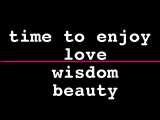
We wanted to evaluate these desires in light of the previous work with wants and needs, so we all voted to see which desires best reflected the group’s priorities as corresponding to our real needs. We used our feelings from the guided imagery and the valuations of the "wants and needs" to make our choices. We each had five votes, which were cast by making marks opposite the desires/needs we each thought most important for us. We then correlated all the desires/wants into categories based on which ones got the most votes. The desires/wants that received, by far, the most votes were LOVE, WISDOM, and BEAUTY. This was quite astonishing for me and the group, as I recognized immediately that these qualities are associated in many religious and magical systems as values that carry the deepest and most powerful meaning. The other members of the group were also amazed by our collective choices. We had discovered, through going inside, that all of us carried essential qualities that did carry the meaning that most of us felt we lacked in our lives.
The question raised was then: "How can we bring the inner meaning we find within ourselves into our work and life?" Even at this stage of the workshop, I felt that the initial hypothesis and workshop guidance had been successful. This seemed mutual. Many admitted that even days ago they would never in their wildest dreams have associated themselves, and particularly their work, with such qualities.
We split up into three groups, which further developed the three major categories of Love, Wisdom and Beauty. One of the groups recognized that each quality was expressed in three ways: as products, services, and in immaterial ways. There was a hierarchy within each group, and we discovered that the most powerful and evocative expressions of the three major qualities were the most immaterial. Ideal love, wisdom or beauty were far more powerful and evocative than physical beauty or the family home. Indeed we recognized that we all ultimately wanted to have the ideal manifestations of these qualities even more than the images that symbolize them, the products which carry them, or the services which express them. Services reflected individuals who transmitted or expressed those qualities to others in their lives and work. Products were a poor reflection of pure ideas that lay in the transcendent realm, and were often substitutes for the feelings. We realized and agreed that in our society we are encouraged to attain these ideals by possessing the objects that characterize them instead of expressing the qualities in our lives. Thus, instead of giving our time and love to a partner, we give them a diamond. Instead of taking the time to transmit wisdom to our children, we give them computers. This has given rise to consumerism, the epitome of Western culture, and has fanned the flames of the ecological crisis currently engulfing our planet. We accepted as a group that we needed to begin expressing these essential qualities in our work and even more importantly, in our selves. That is the most effective communication.
The Final Presentation
A few notes about our week of work. Most groups lost members: ours gained members every day. We started each day with a group meditation and that in itself attracted people from the other groups, who would then go on to their proscribed groups. But the word spread, and many people joined us in our process. Also the group wanted to stay with me after we ended each day, long into the evening. The sense of community we had forged was very powerful and no one involved wanted it to end.
I did not attempt to influence the final presentation with any of the underlying ideas mentioned here: the members of the group did it on their own as we watched and supported them. The participants as a group created a collective expression of Designing Desires. Afterwards many of the 1000 people who attended the final presentations on Saturday night in a huge auditorium commented that they found our presentation extremely powerful and challenging, and we were voted the most inspiring group at the conference by the panel of judges. Our group agreed that it was essential for us to further explore our inner reality and at least give it equal importance in the future of our creative and/or business lives.
The participants agreed that the workshop had brought the entire group into commonality and unison on the deeper feelings that pervaded their creative work in the world. Although initially feeling their differentness and individuality, and even their egotism as designers, they left understanding the common bonds that joined us together, forward into our futures.
According to the Designing Desires group, the central principles from which all other desires and needs emanate are LOVE, WISDOM and BEAUTY. Of course love, wisdom and beauty are quite well-known to most people. But are they a cliché, a triviality? Not if you look at designers' deeper and more honest attitudes. The Designing Desires group individuals realized that in their present design work, they did not deal with or express these issues at all. Instead, they were diverted by trivial appearances, function, perceived function, financial considerations, and were most often derailed by the obvious mechanism of satisfying their clients, students, and often, themselves.
The central principles of Love, Wisdom and Beauty have three levels of manifestation: in the CONCEPTUAL, because they exist primarily as values, concepts, archetypes, or ideas; in the SERVICES of life as actions and professions through which people express themselves and do their work; and in the most tangible form as PRODUCTS which embody these principles.
Love, wisdom and beauty manifest themselves in objects and services, but cannot be added onto them. As designers, we want meaningful designs that embody values like love, wisdom and beauty.
Some phrases were created by the group for the final presentation. They were shouted from various parts of the conference hall in each of the nine languages spoken by our team:
"Give love instead of a gift."
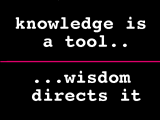
"Knowledge is a tool: wisdom directs it."
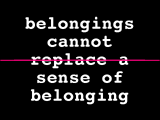
"Belongings cannot replace a sense of belonging."
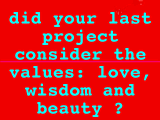
"Did your last project consider love, wisdom and beauty?"
Or a very perplexing thought for us today:
"Our grandparents took pride in their wisdom.
Our parents took pride in their knowledge.
We take pride in our @ccess to inform@tion."
N The Designing Desires group, in conclusion, asks you to consider these three of many possible questions:
* Did your last project consider the values of love, wisdom and beauty?
* If gifts are a substitute for love, wisdom or beauty, why not give the real thing?
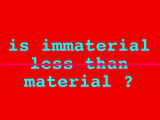
* Is immaterial less than material? No, it is much more....
Link
to "Sacred Architecture: The Essential Astrological Component"